Oedipus Rex - Pier Paolo Pasolini (1967)
TÍTULO
Oedipus Rex
AÑO 1967
subtitulos
Si (Separados)
 DUREE
DUREE 104 min.
DIRECTOR
Pier Paolo Pasolini SCRIPT Pier Paolo Pasolini (Work: Sophocles)
Several
MUSIC PHOTOGRAPHY Ruzzolini Giuseppe (B & W) CAST Silvana Mangano, Franco Citti, Alida Valli, Carmelo Bene, Julian Beck, Luciano Bartoli, Ahmed Belhachmi, Pier Paolo Pasolini, Giandomenico Davoli, Davoli Ninetto
PRODUCER
Italy-Morocco Co, Arco Film / GENDER
Somafis Drama a prophecy to be the murderer of his father. But the child is saved and adopted by the king of Corinth. Without knowing its origins back to Thebes when it is grown and crossed paths with Laius. After discussion, it kills, not knowing it was his father. Later in Thebes married the widow of the king, namely his own mother. (PRO) Download links (cut with HJ Split)
http://www.mediafire.com/?w55bqpbjw7yrlcd http://www.mediafire.com/?ryab0zwsy32g17t
http://www.mediafire.com/?5nklr8j5wqr5087 http://www.mediafire.com/?u0n0xk30t3r01wt
http://www.mediafire.com/?r33mvuljt79m820 http://www.mediafire.com/?dhqdqvl0l9p39od
http://www.mediafire.com/?7frr2eg91mzb9ur
http://www.mediafire.com/?mz32yq7kzs32314 Subtitles
http://www.mediafire.com/?tkyszv8lbx72fz9 Oedipus, son of Laius
Done written by Pier Paolo Pasolini, the film is based on the tragedy "Oedipus Rex" and "Oedipus at Colonus" by Sophocles, written in the V century BC, and personal experiences. It was filmed between April and July 1967 in Bologna, Tuscany and Morocco and in studies Dino de Laurentis (Roma). Nominated for the Golden Lion in Venice, Wins Two Nardo d'Argento. The action starts year 20 in Thebes (Greece) and ends at the outskirts of Thebes around AD 65. The film contains autobiographical elements of analysis that focus in the first half of the film. Fearful of having the syndrome of Oedipus, Pasolini decides to confront him with the completion of the work. The film places the viewer to a troubling reality to provoke reactions have it: life is a dramatic and tragic experience, the frustration and pain proliferate and imposing, life is capricious and hazardous to humans whom he treats like toys of fate, life appears clad in a bushy appearance of fatalism, misleading and false, which leads people to surrender their future management. The oracle of Apollo is not telling the truth, the destination is not predetermined, fate is not mandatory. Oedipus lacks information on their origins and therefore wrong. Do not know your past and not investigates. Faced with uncertain indications, flees in fear and without thinking. The parable of the young Oedipus suggests the need to seek the truth and abandon the fatalistic myths. Human beings can and should govern their destiny. The parable of the old blind Oedipus suggests that blindness of mind of the young Oedipus was terrible. Pasolini takes up the theme in later works and leads to fever pitch levels in Salt ².
The story mixes fiction and personal recollections in a series of sequences that move the facts from the 20 in Thebes, the last of the WWII in Bologna (where he was born in 1922). Distortion becomes apparent chronological indications ostentatious (monarchical Italian flag hung on a balcony). The events of the 20 to 40, located in Greece (Corinth and Thebes) and the 60's moved to 1965/67 in Bologna. The handling time is a resource that the author uses in other works. In this case we can strengthen the sense autobiographical, to remind the audience that attends a fictional story, to wake him on suspicion of being manipulated, move him to not accept the myth and encourage him to seek the truth. The music incorporates
fanfare, a fragment of the Quartet of dissonance "by Mozart and folk songs in Romania, Japan and Morocco. Photography makes use of a restless, observant camera, performing sweeps of landscape, framed broad perspectives and deep earth tones used in preference. The script, poor dialogue, puts into the mouth of Tiresias claims about the strength and effectiveness of learning.
King Laius of Thebes (Luciano Bartoli) and his wife Jocasta (Silvano Mangano) are parents of a child weighing about omens say will kill the father and mother for his wife. Laius ordered a slave to her death on Mount Cithaeron, but softened the leaves. Is collected by a pastor who offers Polybus King of Corinth. He and his wife Merope (Alida Valli) adopt it as a child. Fortunate position lets you take a life of leisure and whims. Visit the oracle of Apollo to know his future. Horrified by the revelations and the purpose of saving the life of Polybus, flees on a journey without destination, which leads him to Thebes. Oedipus, blind, uses the help of a seeing-eye, which is his daughter Antigone.
Oedipus, the son of chaos
Thinking about this tragedy should lead us to wonder to whom it is written. The audience that first received (the Greek people) was so strong that bear the harshness and pain of history. It's all a show tragedy, a window in which to appear at the maximum storm without being touched or a drop, being this itself an educational exercise in which we learn that life often leads to random paths.
is a lot of wisdom that can hide a movie based on a Greek tragedy, but as the focus Pasolini's intellect, leads us to think of life as learning and realization of our character assigned by the gods. Finally we just where we started, only having committed numerous errors with a memory of what happened and with a sense of finishing what has been done that makes a certain melancholy without bitterness and without moral judgments. Pasolini filmed
When Oedipus Rex in 1967, all we read Mircea Eliade in The Myth of the Eternal Return. From there, I think reading that made Oedipus Pasolini filmed in Turkey, Bulgarian music. His approach is not from Freud, but the anthropology of religion and social concern and that is why the prologue places the birth of Oedipus in a villa presfascista Lombard Italy, and the epilogue places it, now blind and wandering in the 60 Bologna. Pasolini
Unfairly, Oedipus is cursed by fate before birth: it will be husband and son of his mother, father and brother his children, his father's murderer. And it is abandoned in the desert to die. However, the same fate decides not to be so, and Oedipus is picked up and adopted by kings of Corinth. Blind to this truth, he does not know, Oedipus grows happy and proud of himself for being the son of kings, with the blindness of youth unconscious treacherous, but, faced with the unfathomable mystery of the oracle, he will reveal his terrible fate.
Oedipus puts his eyes covered in each junction. Turns on itself, unconscious, blinded and destiny takes him, it will gradually lead to the murder of Laius. For a pittance and a misunderstanding pride, Oedipus finds his real father and kills him, ignoring his true identity: that is, kill him blindly. Emboldened, the Sphinx kills also terrifies the Thebans and get the reward-punishment promised to marry the queen Jocasta, his mother. A Jocasta, Oedipus loves her passionately, furiously. Not knowing what is your mother, she is everything you want. And she in him. But the disorder ethical, moral and social causes present when the plague appears and dying animals, men, children across the city. Who says Oedipus is responsible for all this? Oedipus is blind, unconscious, unaware that he is the source of the chaos and destruction.
appalled by the crime, hangs herself and Oedipus, now see the reality, is blind. It is the paradox of myth. Take the pin from the dress of her mother and start loving eyes.
From the moment who knows the truth, Oedipus must err on the world. But Pasolini's Oedipus end in the streets of Bologna in the sixties. Because his Oedipus is a modern man who is dragged, unarmed, by an unknown destination, to which he is blind. And that man never learns that he is causing the chaos that erupts in the world, and whose destruction he has caused. Modern man is a blind man, that ignores the voices of fate, a man who, blindfolded, turns on itself and takes a road blindly without knowing where it led: always blind, always unaware of what's to come. Until the chaos and destruction settle in their lives, tearing. Then go. And he begins to travel the world, lost to himself. aspects of Greek tragedy on film: Pasolini's Oedipus
Ancient Greek and Latin cultures are the basis of contemporary European culture. Only the influence of Jewish culture through the branches of Christianity have a comparable presence in this environment. Nothing particular is then that the seventh art to reflect them from their very inception. Plenty of topics about the history of ancient Rome and Greece make some notes on the film as a source of legends classic seasoned to taste of culture consumption of the twentieth century, at least until the sixties, even though they have never ceased to occur sporadically. Since the seventies and before, the TV series also have trodden these paths. This corpus consists of several hundreds of movies reflects, he said, historical arguments turned into reading novels in the style of the historical novel, which is in excellent health and is the subject of recent studies, "which cements the most popular gloss cinematic expressions of Greece and Rome . The historical novel and classical historians themselves, plus the contribution of William Shakespeare, constitituyen most obvious block the presence (Greco) Roman film. But it is only the tip of an iceberg. Classical literature, tragedy, comedy, novel has also treated with some frequency, although not as much as could be expected. And the myth became a legend shot is present in a negligible block of films, whose number ranges from early twentieth century and the fifties to the emergence of the curious phenomenon that was called neomitologismo and lasted an intense decade from the fifties and sixties. In contrast to the historical film, whose most notable works, except the extraordinary Cabiria (1914, Giovanni Pastrone) and Fabiola (1949, Alessandro Blassetti)-are American, the mythological is a European phenomenon, basically British Italian remarkable contributions. The myth, finally, is present in much of the existing universal films, from the interpretations of Freud and his disciples, but the lesser-known influence that culture has contributed to the film classic, has been the narrative theory supporting it from the most basic concepts to the poetics of Aristotle, the first manual renowned screenwriter.
on tragedy and film
The presence of Greek tragedy in cinema is not as common as might be expected. The classic drama, as verbal-is outside the cinema until the invention of sound, although the curious pioneers soon. The first approach should be considered something like 'Art of tragedy': Prometheus and Oedipus Rex in 1908, new approach to Oedipus in 1910. Electra also an American. A final serious attempt in silent period since 1927, Greece finally Demetris Gaziadis director, is Prometheus Bound. This film is a document that records a performance of the play by Aeschylus on May 9, 1927 at Delphi, a historic moment in the recovery of the tragedy as a public spectacle for the Greeks. In this production, which we consider interesting but anecdotal, should skip to the end of fifties, where they again attempt to immortalize a representation of Oedipus, this time the festival Ontario between 1954 and 55. Contributes little except theater history. Another attempt to get closer to the Oedipus of Sophocles is the Saville Phillippe notable film in 1959. Some other films, with varying degrees of success or originality, date from the sixties and early seventies. Perhaps the first attempt to create cinematic rigor is Antigone G. Zavellas (Greece, 1961). Although the sets were theatrical and technique of the actors, there were elements of script, scenery, lighting and other details of adaptation. The only filmmaker who could called 'specialist' in Greek tragedy is Michael Cacoyannis that produced a trilogy of Electra (1961, Greece), The Trojan Women (1971, USA), Iphigenia (1976, Greece). The unexpected success of the first, let him enjoy the prestige necessary to try two more times. The other two did not achieve success, despite the excellent performances of the actresses, music master, photography, including its political value. I'm not going to extend into more historical data. They are worth to put the environment in which Pasolini frames his personal vision of the tragedy in the years when the new waves were already in decline and sought its new routes.
is not uncommon that the filmmakers have sought renewal in a return to the classics. It is true that Pasolini, in dealing with classical subjects, was at that time to move on theoretical and ethical grounds while experimenting with the metaphor, more fortune, as in Theorem (1968), or less, as in Porcile (1969 ) But, probably in personal crisis, Pasolini wanted to make a trilogy, a classic trilogy. Re Oedipus at hand, opened in 1967. The great success of Electra, "commented before, had preceded him and other notable version of Oedipus, by the distinguished British director Philip Saville with an impressive array actors. There are years apart, but should be considered the slow pace of European distribution. Oedipus was followed Medea (1969). But the trilogy was frustrated Notes for an African Oresteia (1970), almost in the same year. It was a curious trial that barely knew the distribution of the film archives at the time. This curious trilogy "classic" clearly revisionist concept of classicism generally preceded his "trilogy of life"-Decameron (1971), Canterbury Tales (1972), The Thousand and One Nights (1974) - the only time a race euphoric depression, which was imposed in Los hundred twenty days of Sodom (1975), on the works of Sade, which probably got the toughest moments in film history (and there is much competition.) Was this his true and ominous tragedy. Gasoline did not survive the work. Was destroyed, they destroyed. Theorem-a little story today cryptic and hard to follow, had been a real punch in the nose of the society of the sixties. The one hundred twenty days of Sodom was a kick and below. Gasoline in 1975 showed that a poet could seek death in his works. But my intention is to try to re Oedipus (1967) and it seems vain to note that Pasolini was paced by tragedy and the myth before reaching the full joyous life of creativity. Do not forget also that if in the sixties the Greek tragedy had opened a gap brief public interest, and before the film authors, the phenomenon also existed in the theater of the time from a few decades earlier. From Pemán Sartre, Cocteau Vallejo, classical theater alive. Pasolini was no stranger to this European trend. He had translated the Oresteia to the popular theater of Vittorio Gassman in 1960 and in 1963 published a version of Miles Gloriosus under the name of Il Vantone. After Oedipus re also undertook the writing of tragedies in verse as Porcile, Gang Bang, Pilade. Became the first film. Pilade premiered at Taormina in 1969. Maybe he did Pasolini-evolution happens sometimes that the poets represented the social crisis that housed.
On Sophocles' Oedipus
As conceived by Sophocles, dramatic plot was discovering the life of Oedipus, by way of research. Many authors have compared it to a thriller. Recall the plot lines. The people of Thebes, Oedipus is presented to their king, to demand the solution of the plague that ravaged the country. Creon has gone to consult the oracle of Apollo at Delphi. The answer is that Thebes must be purified from the blood of its previous king, Laius, who died in mysterious circumstances during a trip. Oedipus curses and condemns the guilty. The chorus of Theban nobles proposed to consult Tiresias, the seer. The query is complicated. The fortune teller gives cryptic answers that irritate the king. Tiresias accuses him finally directly. The king in his confusion progresses and accuses Creon of conspiracy. It comes, face and tertiary dialectically Jocasta. Oedipus gradually intuit the truth. Jocasta account what you know: Laius was killed at a crossroads at the hands of bandits. Oedipus tells his story. He lived in Corinth and marched from there to evade the prophecies of Apollo. According to them, kill Oedipus his father and marry his mother. The fact is that killing a passenger. A messenger arrives from Corinth. Polybus king is dead and Oedipus can claim the crown. Given its concern about the prophecy of incest, the courier confirms that there is no danger: it is adopted. He himself was a child in diapers of a shepherd from the house of Laius. It seeks the pastor, who confirms that the child is, indeed, Oedipus. Back to the palace, where he finds Jocasta hanged and he out his eyes in pain. A servant announces it. Regent Creon and Oedipus is charged with the custody of their two daughters, Antigone and Ismene. King Oedipus moves from happy to be a miserable, unable to help, without country or home. The choir thought-provoking.
And
Pasolini's Oedipus in Pasolini
also carried the nickname "Son of fortune." And it is so misguided. It does not follow at all Sophocles, although he gradually Aceca Avenue work progresses. Pasolini chooses the diachronic narrative. Diegetic narration. And the relative in waves upward sloping. Oedipus goes to the probable misery, the risk of not having a story-a happy childhood and youth. From here, you should go looking for an oracle no less desert-down, lost his fortune, new risk of loss of history itself. Prophecies are against it. Then follows the course of passage marked by the error. The only way that is, to nowhere, is denied. He was away from his destination. Following an attempted acceptance, a violent outburst against those who prevent him from passing. Several deaths. Seems to trace back his fortune and comes to Thebes. Ends with the Sphinx, also in an outburst of violence ", he welcomed him as king and queen marries a widow. Happy maturity. And again the fate that threatens its stability. Other violent reactions against those who oppose his happiness, the happiness of his people, his city. This time, the violence bounces the messenger Tiresias, Creon and Messenger and relentlessly final falls on itself. Loses everything and will miss forever. Pasolini
allowed to start their work with a prologue in Lombardy in the time of his childhood, perhaps in times of any child. A sudden flashback back to the origin of all to a desert location that replaces the Cithaeron, the foundations of European culture: a culture that Pasolini not imagine so pure and classically Greek and playwrights. Thus, the environments are desert, perhaps Mediterranean, but with suggestions, central, with evidence of North Africa. The dwellings are decidedly protohistoric. The headdresses, which are difficult to locate, with a designer's imagination D. Donatti unleashed production limits, as only Pasolini and Vittorio Cottafavi-the master of the "peplum cheap"-knew it, this one with style "kitsch", the one with flashes of anthropological museum. Do not expect a Greece of Doric columns and short tunic. The two finished by Pasolini tragedies happen in some remote place historically, that bases its identity on the mixture: the mixture of Balkan and Moroccan faces with those of boys in the neighborhood of Rome or Naples or the serene classical beauty and Alida Silvana Mangano Valli, in Oedipus or the powerful features of Maria Callas in Medea (1969). Also in the mix of landscapes and architecture primitive, Music, and the sounds used in Oedipus Bulgarians. Bizarre headdresses and weapons. Even landscapes contrast between the countryside around the scene of the prologue and the desert environment almost all the rest.
An epilogue returns the story to a contemporary moment in which Oedipus blind, walk, unable to perceive unaided life goes on around them. Still, walking and walking, accompanied by seeing-eye that was already in ancient tragedy. From the steps of bourgeois culture to the suburbs is looking for something that escapes us: The landscape of her childhood, when his mother took care of him. Perhaps one Athens you accept, a Theseus who host them. Working-class neighborhoods were, in short, the land that deserved the blessing that God had promised for the last residence of Oedipus. The landscape near his childhood, the mother's womb you want to retrieve.
can interpret the work as reported in three movements and epilogue, where the first movement would correspond to the Italy of 1920, the second exposure to the teaching of the myth, the third to the conversion of myth in tragedy, the epilogue Oedipus the erratic start to the final based search.
Oedipus and neuroses
Audiences not praise this flirting with time, by making the story of Oedipus in a long flashback to the origins of civilization, a flashback that takes the place of an elliptical narrative that robs us: the life of another Oedipus, Oedipus modern happened to draw the attention of his mother, to show his father that he was not the only man at home, blind to wander the streets. Perhaps the life of the modern Oedipus, whatever it is, is a wandering in search of identity. And that, when discovered, no Oedipus is able to deal with it and prefer to deny the vision. Roberto Laurenti has rejected any reading Pasolini psychotherapy of his work, which was interested only a political interpretation "modern" Oedipus leaves the city center to find a proletarian environment.
However, to reject interpretations both psychological and anthropological educated, Pasolini exudes wisdom in both fields. It is not easy to accept that innocence. For example, Oedipus's father takes him by the legs and feet the creature is tied ancestral life. A brilliant concatenation syntax serves as a link with the "flashback." In a reading psicoanalítica1, foot means the soul, the soul that leads Oedipus wound in his existence: man must be a nervous and insecure, which will seek its equilibrium without his own spirit-killing the father and dedication to earth-marry the mother. Or to the contrary, renounce his evil spirit, kill the father-and focus on the sublimation of earthly marry the mother. No matter award the positive role either. Always remain functional opposition. Oedipus generates a nervous man who loses his temper. It is easy to overlook how precisely are the traits of uncontrolled treated Oedipus in Pasolini's work. Is he just as well, who better reflected in the film the basic innocence of the character. Fortune, in effect, you drag. There is no sin in it. Only left to their fate. Carried away by circumstances. Is left wanting when he wants, but fled when their presence may be harmful. Flee when you think you can damage the parent that is natural. Run away when the cause of the plague. This is where you leave and where you check the lot, is gone.
And a few drops of "Poetica"
is true that these observations lead us to Aristotelianism present in Pasolini's Oedipus. Aristotle, in fact, recommended in his work, Theophrastus then develops the idea, that the nature of the characters to be expressed in their actions and should not be reported. Insecurity psychoanalytic reading that brings the character of the myth of Oedipus, it shows in their hesitations and nervisiosismo in reaction to the Sphinx and Layo. Jocasta's passivity is also a character trait that defines it. Is able to access, resignation, work. Courageous women do not respond to classical canons. Medea is something else. Has features divinizing. In re Oedipus, let one part of the action is justified in critical incidents and the solution is given by recognition, the recognition of their own personality to him unknown. Nurses, messengers, servants are respected. There's even a chorus that does not recite, in Medea, yes at times, "a person choir, the people you need the author pressed for exhibition dialectic. The dialogues agonizing, finally, serve as a vehicle for confrontation with Creon and Tiresias. This technique Aristotle begins with the 'tragic' as opposed to the legendary, explained as oriental models.
To avoid hagiography
re Oedipus interest lies in its history and the way it is told, and in its temporary space environment, landscapes "inside" his study of the human soul the strange selection of music. Is an important film, but not a movie round. Above all, there are vast differences in interpretation. Faced with a remarkable image of Silvana Mangano, who has just-as befits Jocasta-text available, Franco Citti gives the type that Pasolini wants, but is unable to say the text. As Ninetto Davoli. Dan type, but are unable to speak. They say that Pasolini film I knew nothing when he started learning it and that was self-taught as they tell of Orson Welles. Neither one nor the other is in fact credible. Pasolini may not have been trained in the technique of the screenplay, but his training in the classics amply compensated. His narrative is correct. Slow to the overwhelming, but it was the fashion of the time and he was recognized Mizoguchi stylistic debtor. Take for re Oedipus story that triumphed in Japan, when Europe, except France and-relatively-Italy, had been ignored. Was able to put their theoretical knowledge of the narrative, and experience in script was already known when re Oedipus rushes. But the concept of production control which should clothe the director, is not the same in the U.S. than in Europe. If Welles had secured the technical control of the film, Pasolini no. So the first work of Welles is a masterpiece. Why did Pasolini masterpiece ever. Create intelligent men he thought Welles-and it is true in American cinema. Intelligent men in Italy -Or Spain-created, but leave the "finished" fatal. Pasolini failed in the assembly, the pace and direction of actors, who preferred to turn to avoid trouble.
"Sons of Fortune" and a mother
Oedipus was high on site pasoliniana required. A tragedy foretold. His work is full of "children of fortune." It seems, therefore, we should interpret the error, the inability to stabilize one of the key issues in Pasolini and that is also looking at its tragedies theme "classic." In Oedipus and Medea is clear. In Notes for an African Oresteia not tell. The documentary is purely a trial, seems to be devoted to humans as a species, forgotten modern peoples, but also to the origins of civilization (an African origin). Orestes was also called to live in Pasolini a rite of passage, where Africa would represent the current version of the classical: Orestes bring democracy to Africa as a modern Argos His work, in fact, is full of children and a mother. As he turns father figure, just a wife. Accatone (1961), which follows the line of his novels - "Ragazzi vita" and "A violent vita," is already a boy seeking his place in life, a boy who feels no need to adapt to what is socially correct to start a family should. There is no place for him. Shortly ago, follows the paths that are presented and no leads to port. It is, yes, a character will archangelic as Jesus Christ The Gospel According to St. Matthew (1964) or Theorem Young (1968). Also Mamma Roma (1962) presented the boy with no place in life and, even more than Accatone (1961), and then an introduction that leads to death.
And I have not come without meaning to the theme of initiation, because Pasolini adapted the story of Oedipus re (1967) to highlight this aspect, which fails to crown, but will resume in Medea (1969), where he takes on a conscious and didactic. If Oedipus is brought up for adoption and we see with the youth of his time, Medea Jason presents a pupil of Chiron, a centaur taking when the camera is the point of view of the child and man, when one has already " use of reason. " It is a simple and educational interpretation of the myth that Pasolini. Both young, as young Pasolini's life, they develop in their midst, but aspire to the family when they know it. Neither nor any other hero pasoliniano, get indefinite stability. In Medea even Jason's character loses his role, although the story has begun narrating his life and his adventures as in Oedipus re. Jocasta is a quite dull and not the fault of Pasolini. The tragedy does not give a really big role. In fact, the version that gives discussed features Polybus's wife, the adoptive mother of Oedipus that he worships and gives the sweetness that the years had given to Alida Valli, one half aside and actress at the time, but had its moments of splendor in the forties and fifties melodramas usually torn. Jocasta chose to Silvana Mangano, who represented a mysterious wife and unsatisfied, which influenced later theorem character, where the angel pass away her husband and takes her bed. The prototypical mother had been years ago Pasolini, Mamma Roma, Anna Magnani overflowing with love, energy and dignity. Pasolini Maria Callas The shapes in his work, always reminded me of Anna Magnani, especially at times when reciting the poems that Pasolini himself added to the text tragic.
Pasolini, the myth and the public
re found in Oedipus myth and history, Pasolini and his past, he and his audience, in a complex. Pasolini's Oedipus as an insight addressed and will autobiographical. Wanted to investigate the origins of his existential angst, but sought to transcend the tragedy and better approach to "popular origins of the story", to achieve a modern reading of the classic myth, its universal values. Metaphorical autobiography, which is scored to create a modern Layo officer, as Pasolini's father could be the autobiography of half of humanity seeking its path. An essay, after all, about psychoanalysis and myth, as he considered all ideology inherent in the parent-child relationship. The beginning of the work is lyrical as poetry is childhood -The idea is repeated in Medea, and the past, surrealistic as remembrance. The long and difficult flashback where myth and tragedy are intertwined, then, the dream of the collective unconscious. The turn-entry into reality-an absolute present, presents the subject-only metaphorically blind man whose neurosis deserve attention. In Sophocles, the causes of neurosis are represented by the gods. But nothing is under human control, the subject is not prepared to face the facts and this generates tragedy. Sophocles' Oedipus is innocent, is not actively involved in anything. Pasolini decides to emphasize this idea, making his character into someone who gets carried away and wonder why nothing, not an intellectual, and never are his characters ("except perhaps in Theorem?).
had planned to shoot in Romania, where he thought he had found ancient European landscapes. Not so. Paradoxically, the past had disappeared under the industrial revolution. However, he found the music in a folk song where the Arabic, Slavic and Greek mixed in difficult discrimination. If few people would recognize these melodies, the music would be out of the story, as was the case with Oedipus had imagined.
also felt the need to subtract solemnity the tragic story. Should reach everyone, however contradictory thought the static narrative style oriental style. I also wanted to oppose the Hollywood melodrama, with the costumes and props with wicker, leather, sheepskin or goatskin, colored stone ornaments or shell.
With all this effort was designing the public who wanted to reach. But he failed: the work was and is important for intellectuals.
Among the various relationships were established between film, myth and tragedy of Electra Cacoyannis to Dassin's Phaedra, through the analogy between the Oresteia and the return of soldiers of the Korean War that occurs in The Manchurian Candidate of Frakenheinmer-all of the 60, Pasolini's contribution is the most rigorous in that it includes a research, analysis and study sources of treatment and a translation by the author. His tragic trilogy is a classic demonstration of the foundation of modern culture in Europe, anywhere and at any time, as all film production is based on that culture, even ignoring it. Pasolini used psychoanalysis to emerge that consciousness and left, among other literary works, his re Oedipus, Medea and test your Appunti per un Orestiade Africa. Scholars the classical world and its traditions should also not ignore. - PCL
http://www.claqueta.es/1965-1967/edipo-rey-edipo-re.html


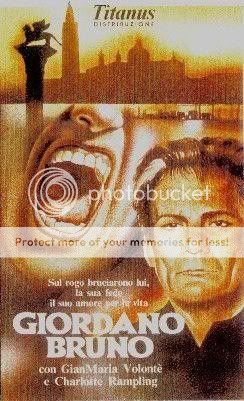
 Giordano Bruno
 MUSIC
MUSIC 

 Download links (cut with HJ Split)
 Co Italy-France-Germany; Offside / Les Films des Tournelles / Mitteldeutsche Medienförderung (MDM) / ZDF Enterprises / GENDER
  http://www.mediafire.com/ ? a6z7s5tmknzq525
  http://www.mediafire.com/?42a9h58a8a2ag2r
  DUREE
DUREE 

 Luigi Lo Cascio, Tony Sperandeo, Ninni Bruschetta, Lucia Sardo, Paolo Briguglio, Luigi Maria Burruano

 http://www.mediafire.com/?djrkay1tf523rf5


 http://www.mediafire.com/?9vn4n23azshhu78
 http://www.mediafire.com/?3f154y1g1eh43d1