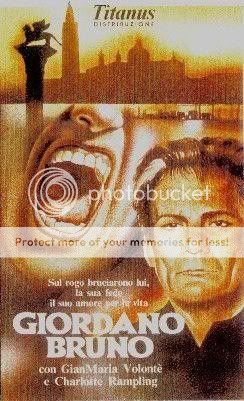
Giordano Bruno - Giuliano Montaldo (1973) Band of
YEAR 1973
SUBTITLES
Si (Separate)
DURATION 114 min.
Giuliano Montaldo Giuliano Montaldo
Vittorio Storaro PHOTO SHARING
Gian Maria Volonté, Hans Christian Blech, Mathieu Carrière, Renato Scarpa, Giuseppe Maffioli, Charlotte Rampling Co
PRODUCER Italy-France, Compagnia Cinematografica Champion / Les Films Concordia GENDER
Drama http://www.mediafire.com/?1ggwn9sifxxv667
http://www.mediafire.com/?wz49oiu3g8b3kcj http://www.mediafire.com/?0n5bn4bbm2z6nr0
http://www.mediafire.com/?pav1kr01wvhk1t0
http://www.mediafire.com/?adqlqidajib2wye subtitulos
http://www.mediafire.com/?221qgfvb12628uq not import weapons and the battle for freedom of thought is the necessary step of every civilized man, now that new and more powerful threat to the feudalised consciences to the myth of welfare, order and technology. Historical place of choice for this battle has been for centuries the Catholic Church possesses the truth and elettasi target of any polemic aimed at freeing the individual from fear. Today the situation is changing, thanks to the recovery of an area by the church of the value of all religious experience is not compromised by power, but the past is too full of crimes and mistakes because consciousness does not continue to lay draw strict warnings, and see symbolized the risk faced by each company to identify dissidents with heresy. The film by Giuliano Montaldo Giordano devotes hours Bruno is to be read in this perspective. The author's first resignation in fact the ways of the old anti-clericalism. The frequent references to current, ml'orizzonte is much wider: burned yesterday by the priests, Giordano Bruno is now also a victim of Stalinism, the pyre is lit up by the military Greeks and Chileans. His tragedy is that its judges, came to us from the seventeenth century, casts a dark shadow over all our times and on the uncertain future. No ambition in monographic Montaldo. The figure of Bruno is too complex, nourished by religion, philosophy, science, magic and literature, and his life too thick to be hoped that the cinema, this new kind of adult education, is able to fully express. The film therefore only describe the last few years, between 1592 and 1600 and short flash-backs, flash memory, which makes us relive the highlights of the events passed. ; ; Having just been tumultuous
experiments in the European courts, Bruno was in Venice, a guest of Mocenigo hoping to learn that his alleged magical arts introduced him into lavish salons of Venice. Bizarre and contemptuous, Bruno does not mind the booze and the favors of courtesans, but continues to spread his pantheistic conception of the universe and his idea of \u200b\u200ba new man, free from prejudice and in harmony with nature. It is clearly outside the Church, which has good game in return to accuse him of infidelity. When Mocenigo, scared and disappointed, the denunciation to the Inquisition, Bruno ends up in jail. Jealous of its prerogatives, Venice Vatican wants to avoid interference, but the reason of state prevails: Although Bruno has recanted (so you can still be free to think and act), the process moves to Rome. Here the pope, Clement VIII, is full of doubts, because despite being subjected to torture Bruno is back to reaffirm their ideas, and the Inquisition is divided, each seeing in him a weed to be eradicated, others fearing that a conviction bears further damage to the catholicity, already torn by schisms and wars. Quado some of his fellow Glera, denouncing the revolutionary theories, come to the rescue of the more rigid the Inquisition, there is no escape for Bruno. Despite the intervention Cardinal Bellarmine, the most cunning, the persisting hamletic of the Pope, and Bruno himself merely to confess guilt of innocence, the verdict is irreparable. Delivered to the governor of Rome, in February 1600, the Dominican rebel rooms at the stake: a vice, yet closes his mouth, while the meat is burning in the silence of the onlookers. Preceded by a serious documentation, the film continues the discussion on the misdeeds of the power of Montaldo (Gottmit us, Sacco and Vanzetti) with strong moral conscience, satisfactory references to the historical situation, a full staging and a sincere effort to break the knot of the tragic events . The attempt to make Bruno a precursor of socialist revolutionaries, those who criticize the church or simply from the last samples of anti-authoritarianism, and here and there a little 'forced, and leads to schematization ungrateful to those who know the life and work of the philosopher from Nola, but to the extent permitted by the cinema of consumption the human and ideological substance of the drama is expressed in vigorous style. Director of Pulse, Montaldo recalls the pomp and damaging period with full-bodied taste of the atmosphere, and trying in various ways to weave the fabric of the work realistic wires fantastic along which passes the true nature of visionary monk. His Bruno has perhaps a bit 'too much on the features of spiritualism, but otherwise the film would have avoided the shoals of didactic el'uggia of libel. Belong to the repertoire of clichés but the figures of a luxury courtesan, fascinated by the personality of Bruno (the excuse is good to give us a female nude, blatant penalty in even the most serious directors now know how to escape), and 'a young man captured by his example.
These fines, however, do not call into question the structure of the film eloquence. As already happened with the Cavani Galileo, to resurrect a fateful moment in history, and suggest similarities with the present, the work strikes a good balance between entertainment and culture. Gian Maria Volonte, forced to speak with inflection in Naples, yields to temptation some histrionic, but always as a valuable interpreter that gives resonance to every scene. The remarkable photography of Vittorio Storaro, who often tries to make the climate of the time using a color in which the magnificence of the salons and the darkness of prisons merge into a crock of gold. The scenery is good for Sergio Canevari. Charlotte Rampling Among the performers in costume of Eve, the coloring Maffioli, Hans Christian Blech (the Pope), Mathieu Carrière, Massimo Foschi, and many others, the principles of the church, soldiers, courtesans, Sorbonne and sovrani studenti della ... Giovanni Grazzini, 'Il Corriere della Sera, 30 novembre 1973


 Giordano Bruno
 MUSIC
MUSIC