Monday, February 28, 2011

Calgary Threading Eyebrows Downtown

Salvatore Giuliano - Francesco Rosi (1962)


TITLE
Salvatore Giuliano

YEAR 1962
SUBTITLES
Si (Separate)
DURATION 124 min. DIRECTOR
Francesco Rosi Francesco Rosi

SCRIPT, Suso Cecchi d'Amico, Enzo Provenzale, Franco Solinas
Piero Piccioni
MUSIC PHOTOGRAPHY
Gianni di Venanzo PRODUCER Lux-Vides
GENDER
Drama SYNOPSIS
Biography Salvatore Giuliano, a legendary Sicilian bandit and independence. But as far as Rosie is really interested in focusing on the endemic backwardness of Sicily, on the relationship between mafia, banditry, political and economic power, ie the causes of what Italians call the "southern problem ". (PRO)

Download links (cut with HJ Split)

http://www.mediafire.com/?iyt204pys4yeqdz
http://www.mediafire.com/?7l7dzt51wwipsze


http://www.mediafire.com/?724a7w3jycb8eew
http://www.mediafire.com/?n43w3rl4s71g862

subtitulos
http://www.mediafire.com/?ic5fxebusbdcad2


If you can not say, and was told that Salvatore Giuliano is the "best film of the Italian cinema, "is certainly reasonable to conclude that the third work of Rosi is the fruit most courageous and passionate testimony to the civil law of the" recovery "of these years. If the passion of neo-realism was the rage and impetuosity of his desire to discover, the aggressiveness of its commitment to knowledge, it is found in full in Rosi's film where there is a rib on the other hand the criticism of certain tendencies "retrospective "the Italian production of these years. Deep emotion we feel before certain scenes from the film confirms the exhilarating feeling that Rosie often recalls that he felt, that is, to a film by hitch free from the constraints and the trade and the Convention, in which the moment of creative development coincides with the progressive discovery of the truth of the human condition, a dramatic and contradictory reality of a bottleneck historical unresolved. I think Rosie, in this refer to certain reasons resentful of neorealism in the light of today's most rugged and painful problem, has found the enthusiasm of those who make the movie knowing that an act of witness and communication. This emotion civil, that is the hallmark of the film, its necessary stimulus, then it is also the limit, found for us in the dispersion axis and ideological narrative should support the speech.
node dramatic political and Rosi's film is the death of Julian, whose body riddled with bullets in the back of the courtyard Maria De mark the end of a nightmare and opens with violence as a rational process. Julian is the demystification of the negative moment, and most interesting film Rosi: Giuliano live is a generic, a foreshortened figure in the background of the country, the band, other, Giuliano dead body is a cumbersome and unpleasant that bounces once on the speech others, the environment and forces acting. Julian can not be the star of the film because he was not a hero, because even the southern banditry was never an active, but an instrumental phenomenon, a story of consequences and not causes. Twelve years later, in his attempt to rejoin the non-story of Julian the history of the forces that produced it and of those who have suffered, must Rosi necessary part of there as soon as Giuliano officially ceases to be a character and becomes a problem.
the filmmaker who does not follow, therefore, a faithful and consistent line chronologically, moving from the open questions and unsolved problems of this order to unearth bits and pieces of the truth of the past in a relentless succession and tumultuous, with all the break-up of a chronicle in many respects incomprehensible, a story that has not become history. In the process sequence of Viterbo and restless and disappointed in the face of the court's Randone masterfully evoked by the sign of a desire for clarification and despairing of his impotence, of the many difficulties that hinder the effort officer of reason and the sanction of the law required. The last image of film, with the corpse of the mob knocked down the shotgun, wants to tell us that the chapter of complicity and responsibility is still open, and the film thus tends to extend beyond the limits of his own life, in the midst of society which addressed his speech.
no accident construction style of Salvatore Giuliano suggestively may think that a film that takes us back with mounting evidence of his hot pictures to a recent report, which may already be forgotten before settling into a historical clarification and redeem a lesson in politics. But here the director, who did not work in the field of organization and understanding the material of film and newsreels, but at a higher level, faced with the problem of groped a critical discourse within a creative work, the problem in short, to find a stylistic and ideological axis around which to organize a subject as explosive and burning. And this fact seems to us that he was unable to find a balance principle and consistent ordering of its "news". If the breakup of the time and conventional narrative patterns, based on contamination of forms of documentary and experimental stress some of its European cinema today, has allowed Rosi to alternate between past and present seamlessly and give us an insight into emotional and turbulent of all the members of the Sicilian reality, he has since been forced into a mesh that method at some point ceases to be, as it should, an instrument investigation and knowledge and is likely to resolve itself throughout the film. So the pages dedicated to the Mafia, the "role" played by the police, the macabre farce staged on the body of Julian are not always persuasive, and are those that reveal the limits of certain temptations discovered americanizzanti Rosi. Nor can it rely on the ambiguity of the hot matter, for an episode in some ways already praised as one appears as unresolved separatist and most of the others. If Rosie is essentially intended to evoke the face of Sicily, and a page and still red-hot drama of Italian history, identifying the crucial focus of the dominant forces, banditry and lower classes, it must be admitted that he failed to achieve the balance necessary for his film is devoid of the complexity of design and installations essential. There is no example to those who do not see how the external business of Julian, shot by that operator who is sensitive and rigorous Gianni Di Venanzo, betray the mechanical nature of some readings and American assimilation of the filmmaker. But when Rosie has to accede immediately to despair and revolt of the plebs dispossessed and rejected the edge of the country office will have the most beautiful and memorable sequences of his film: the pain and the desperate protest of women nell'aspra and vigorous sequence of raking Montelepre, the tragic silence that lies at Portella Broom field of the massacre, the rebellion of the young shepherd who unwittingly finds himself involved in the undertaking to find disbelief in the cage of Viterbo.
Adelio Ferrero
New Cinema From 1956-1977 reviews and essays, Alessandria, Edizioni falsopiano, 2005

Sunday, February 27, 2011

Astra 1.7cdtitank Pump Faulty

My Brother is an Only Child - Daniele Luchetti (2007)


TÍTULO My
fratello è figlio only YEAR 2007
SUBTITLES
Si (Separate)
DURATION 100 min.
DIRECTOR SCREENWRITER Daniele Luchetti Daniele Luchetti
, Sandro Petraglia, Stefano Rulli (Novel: Antonio Pennacchi) MUSIC
Franco Piersanti
PHOTO SHARING Claudio Collepiccolo
Elio Germano, Riccardo Scamarcio, Angela Finocchiaro, Luca Zingaretti, Anna Bonaiuto, Massimo Popolizio, Ascanio Celestini, Diane Fleri, Alba Rohrwacher, Vittorio Emanuele Propizio, Claudio Botosso, Antonino Bruschetta
PRODUCER Cattleya / Babe Film
OFFICIAL WEB http://www.mihermanoeshijounico.es/

AWARDS 2007: 5 Academy Awards Donatello Italian (11 nominations)
GENRE Comedy. Drama Francesca, the girlfriend of his older brother Manrico, the main local leader of the leftist political scene. Accio fascist actions embarrass Manrico, and his parents decided to mediate between the two brothers, who no longer speak. The only communication between them is by Francesca. Accio falls in love with Francesca, and the differences and conflicts between the two brothers will reflect a country torn between two ways of looking at life and politics ... (PRO)
Download links (cut with HJ Split)
http://www.mediafire.com/?5zy7zz7hw7tcchx
http://www.mediafire.com/?q8cn1gw7jobxznh
http://www.mediafire.com/?98smlmbz1ys57jk
http://www.mediafire.com/?faxmo5k5oqcgtn0
http://www.mediafire.com/?po6lxqaukc5pat9

http://www.mediafire.com/?ukasuq66s6oouj0
subtitulos

http://www.mediafire.com/?z4hh94ecoakqcu1


emotion the story of the two brothers


Two brothers in the Sixties-Seventies. So different from each other that each of the other, can say that it is Only Child: How the song by Rino Gaetano. They live in Latin America, almost proletarian family, similar only in aggression. The younger, Accio (which is also the narrator), resolves, after a fleeting experience of the seminary, becoming a fascist thug, under the guidance of a bad teacher. Manrico, the eldest, who is a worker, became a communist, always first and most spirited when it comes to hold rallies and declare strikes. Of course they end up putting their differences with violence against each other, even later because when Accio, changing field, will become an extra-parliamentary, Manrico, going further, choose entering the armed struggle even in underground. Despite a young woman has just had a baby. A contrast that Daniele Luchetti, Petraglia and Rulli with rewriting the footsteps of a novel, not great, was able to build strong psychological implications, and let that decade but so troubled social and political background remained intentionally because, stood in the middle, were especially characters who take turns in the provincial framework from which they were made to emerge. Meanwhile, the two brothers are also different in their relationships with women, timid Accio and his first sexual experiences, Manrico not only always ready to seduce, but proud of his skills as a seducer. Both, however, amid disputes, resentments and often beating, linked by a constraint that, during those ten years of conflict, is analyzed in all its facets than answers. Now with almost lacerating tear, now, on the contrary, with notes gathered and subdued.


exact connection with the design-hour-choir individual hour of the other characters around him, in private and public. With a realism that can embrace the record, but with how dry, is the tension of feelings and those of some nasty wheelies steeped in irony. first of all, that hymn to Joy from Beethoven's Ninth modified praises Mao, Lenin and Marx ... Participate directly happy results of these two actors naturally very careful in adhering to the opposing faces that have been asked to recreate. Elio Germano, as Accio, including skilled entanglements, unexpected tenderness, clever bully. Always in moderation. Manrico Riccardo Scamarcio a fiery, determined, but also through it fragility secret. Often expressed with finesse. Do not forget, along with them, Luca Zingaretti, the "bad teacher", and Angela Finocchiaro, often anguished mother of two. Gian Luigi Rondi

From Time, April 20, 2007

Saturday, February 26, 2011

Wake Up In The Morning Feeling Like

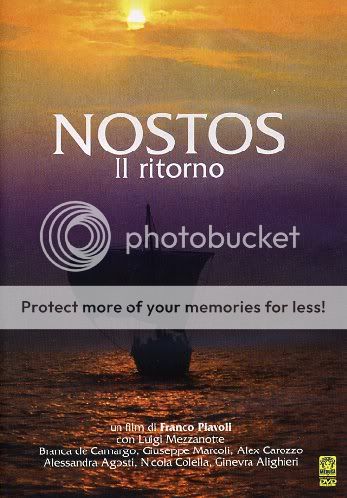
Nostos, Il Ritorno - Franco Piavoli (1990)


TÍTULO
Nostos: The Return
AÑO 1990 SUBTITLES
Si (Separate)
DURATION 85 min.
DIRECTOR SCREENWRITER Piavoli Franco Franco Piavoli
MUSIC
Mazzucca Giuseppe, Luca Tessadrelli Franco Piavoli PHOTO SHARING
Bruno Minniti, Alex Carozza, Giuseppe Marcoli, Paola Agosti, Mirella Fabbri
Cooperative
PRODUCER Immaginazione, Zefiro GENDER
Drama
1990.Presentado out of competition at the Mill Valley Film Festival di San Francisco 1990.Presentado out of competition at the Moscow Festival

SYNOPSIS After remaining many years outside his homeland, the hero feel the urgent need to return to it on his trip by a series of meetings often unusual or mysterious, beyond which eventually rediscover himself. (PRO)
Download links (cut with HJ Split Files)

http://www.mediafire.com/?65jzm9ya8ua01a1
Subtitles

http://www.mediafire.com/?li8i1zre40danvi
Piavoli is the optimistic version, relaxed of Huszarik, his back, after seeing his films is impossible not to be a believer, like Oguri, a cinema cosmogonic, tote, inclusive, universal, sensory natural, absolute harmony between man and land, virgin movie, film renaissance with his feet in the water, films made from Paradise, joyless Mozart, cleansed of sin, shame, evil, pessimism.
Nostos, il ritorno. A stunning reinterpretation of the myth of Ulysses as had done Abuladze, Sokurov, Tarkovsky or more inspired, with two off-field battles that have left speechless Bresson himself, and with the introduction at the end of the same music of Monteverdi Bresson used in "Mouchette" in a way that overwhelms, which makes the hair stand on end, no need for subtitles, there are only images and sounds, the most beautiful, necessary, you've seen, heard, ever. Ulysses
A human, Christian, who returns to the world, the world's children, from the other side of death, Ulysses risen recently given birth, who rediscovers the world, life, every step, every glance, One World, One life, living, livable.
http://cinelacion.blogspot.com/2009/07/ere-temporal.html


Nove anni dopo il successo "Il Pianeta azzurro, Piavoli Franco becomes the cinema with "Nostos - Il ritorno" dove, partendo dall'Odissea, imbastisce a nuova visione dell'Ulisse omer. L'Ulisse di Piavoli eroe è a spietato and crudele but, at some point, he dreams of returning home. And his journey is a return not only in the arms of his wife, but also a cathartic journey that sees our hero purified by misdeeds of the war thanks to the intercession of Mother Nature. It is no coincidence that Mother Nature has appointed either that Penelope, both mother figures "Nostos - The Return", more intrinsically, it tells us nothing but the path of a man who wants to regain his status as a newborn (and thus of innocence). The director expressed it with at least two sequences, one set in the cave, where Ulysses is nothing but the shadow reflected in the womb of the Earth, and that of a breathless swim to the moon reflected in the Sea, which compares (not too subtly) with a sperm Ulysses and the moon with a giant glowing egg. The images that tell us about the journey of the protagonist seem to come directly from "The Blue Planet", but in this case we assume the strong commitment not only to excite the viewer but to become a particular kind of psychological description of the protagonist of the film, choosing that seems to take up the subject of German (although of course, with different visual results). Then there's the sound, a key element in the films of Franco Piavoli that, in this case, does the extreme choice to write the dialogues in a language he invented, which incorporates part of Latin greek and languages \u200b\u200bof the Mediterranean area. "Nostos - The Return" then turns into a movie where there are no words to bring meaning, but it's the guttural sounds of this new language, incomprehensible in their real meaning, but completely clear if there is carried away by their sound. The dialogues and then combine and become part of a soundtrack by well-designed Piavoli, which puts it in an extraordinarily evocative and epic mount (though we imagine that epic far).
to grips with a more robust and complex history, Piavoli again proves to be an original author, a storyteller who knows how to get to the heart of the matter while providing valuable visual drifting, a type of poetry for who knows how to get images in the heart of the viewer.

http://www.pellicolascaduta.it/wordpress/?p=1837


Friday, February 25, 2011

When To Place An Order For A Cake At Costco

1960 - Gabriele Salvatores (2010)


TITULO
1960 AÑO 2010
subtitulos No
DUREE 75 min.
Dirección Gabriele Salvatores Gabriele Salvatores
Guion, Michael Astori, Massimo Fiocchi
PHOTOGRAPHY Marco Sgorbati
DEPARTMENT Giuseppe Cederna
MONTAGE Massimo Fiocchi, Chiara Vullo
MUSIC Federico De Robertis PRODUCTION
offside, Rai Cinema
PRODUCER Mario Gianani

GENDER Social / historical
FESTIVALS

67 Mostra Fuori Concorso Internazionale del Cinema di Venezia

SYNOPSIS Summer 1959. An adult's voice evokes the days when it was just a Southern boy who still knew nothing. The memory of that summer still alive in his memory was the last one happened to his brother Rosario before he was off to the North. After that unites the two brothers are the letters sent from Rosario Milan city has moved. In his letters he tells his new life conquered freedom and their friends, writes about a magical fairy world where everybody gets what they want. Milan appears as the Toyland, a kind of promised land. Are these letters concern the family: Rosario has changed so much that they have forgotten their commitment to Rosalba, the girl of his people he loves and hopes. The family, in order to return the child home, decides to undertake a long journey through Italy, discovering a country that is changing, driven by the economic boom. The trip becomes a kind of sleep characterized by the wonders of Naples and Rome, the Olympics, Fellini's La dolce vita and the Rimini summer of love. However, the objective is still meeting with Rosario. In Milan there is no trace of him. Finally, in the capital's economic miracle discover the truth: Rosario is a laborer, working in the tunnel of Mont Blanc and is an immigrant like many more. His letters were false, had written to his younger brother to hide the harshness of daily life and drama of emigration. But those lies have allowed the player to live the best years of his life, making him realize that people have the right to believe in their dreams.
whole story is based on images of Rai Teche story is rich with images of Rai Teche.

Download Links (Cortados with HJ Split)

Magic and Nostalgia. The story of a boy who wanted to be a magician and became director

Summer 1959. Happy people at sea. The voice of an adult recalls those days, when he was little. The memory of that summer is still fresh in his memory was the last that he spent with his brother Rosario, before the latter left for the north to Milan.
From now to keep the two brothers are the letters sent by Rosario that great city, so far away. He tells of his new life of freedom that has won, the friends with whom he spends his time writing about a magical world, magic where everyone gets what he wants. But are those same letters in alerting the family Rosary, when in Milan has turned into a rebel, he even forgot the promise marriage made Rosalba, a girl who loves his country. Parents understand that something must be done and then decided to go to bring his son home. Begins a long journey in search of the Rosary that will bring this family to cross the whole of Italy and discover a country that, driven by the economic boom is changing before their eyes.

this family's journey through Italy, the dream marked by the contradictions of Naples, where the bar working children, apprentices, bartenders, 9 years old at the Rome Olympics and Via Veneto, where the pitch was enough of a stylish girl (this step only the girls knew of the 60 sickle) to turn his head to the men, the romanticized myth the foreign and the Adriatic Coast. Until arriving in Milan, from Rosario, where they will discover the truth about him.

out of competition at 67. Venice International Film Festival runs Gabrie Salvatores (Giuseppe Cederna law) one year of history: The 1960! 1960 is more than a documentary. Made using material Teche Rai, Gabriele Salvatores fresh and sweet nostalgia tinged with a single period, the economic boom, migration, television and film. 'The film editing - explained Salvatores - may' radically rewrite the story of a film. In general, can 'change or rewrite the history of the years we have lived. Starting from these considerations, we tried to construct a story with real images of television in 1960.''

Nor is it a historical fresco. The installation of this work Salvatores passion, smile, move, because it is the person, man, woman or child, is the face, eyes, hands, are Celentano and Mina, Mastroianni and the Deaf, is the sixteenth century, is the dream become protagonists. Salvatores Italy told through the visual fiction, has used the stock footage shot by others to bring his magic to speak of himself.

to help in this project rushed to the reporter and editor Michael Astori of all his films Massimo Fiocchi. More'''a documentary that looks like a film made of dreams and memories. We would like to thank all the journalists and cinema operators who have unwittingly provided their pictures, which we tried to give new life and new meaning. Beautiful images. It 's not a case that 1960 was a record year for Italian cinema''said Salvatores.
1960, will have a privilege to be able to be seen by a wider audience, it will be broadcast on RAI-3 in October after the broadcast time ago? Salvatore has created a work, a small pearl bright with black and white images that evoke even more sentimental a real, absolutely not corny, and therein lies the preciousness of 1960. 1960 is the story of a boy who wanted to be a magician and became director. Ilaria Falcone
http://www.nonsolocinema.com/1960-DI-GABRIELE-SALVATORES_20962.html

Thursday, February 24, 2011

Prijs Frontelement Lens

The Poet .. UNLUCKY-R and that he could not enjoy his fortune!


http://appuntamentiacr-onlus.blogspot.com/2011/02/benigni-cavallo-festival-2011-acr-il.html
Oscar Int. Poetry against bullying. In Photos: poets and Luigi Luigina BUILDINGS PERFECT with Pasquale SALVATORE President of the Jury Prize for Poetry and Artists against bullying and Sergio Dario Merzario President of the RTA!
www.acraccademia.it

Luigina Palaces The Poet recites his poetry and tells his story .. and withdraw the prize was ranked third!

Does Yogurt Have Milk Worms In It

gold-rimmed spectacles - Giuliano Montaldo (1987) Notes Of A Block


TÍTULO glasses gold
AÑO 1987 ;
subtitulos Si (separados)
DUREE 110 min.
DIRECTOR Giuliano Montaldo
Guion Nicola Badalucco, Antonella Grassi, Giuliano Montaldo, Valerio Zurlini (Novel: Giorgio Bassani)
MUSIC PHOTOGRAPHY Ennio Morricone
Armando Nannuzzi
CAST Philippe Noiret, Rupert Everett, Valeria Golino, Nicola Farron, Stefania Sandrelli, Roberto Herlitzka, Riccardo Diana, Anna Lezzi
PRODUCER Co Italy-France-Yugoslavia
GENRE Drama race and sexual orientation in Fascist Italy, 1938. (FilmAffinity)
descatga League (cut with HJ Split)
http://www.mediafire.com/?6no99fceb512kco

http://www.mediafire.com/?b5v8ixqoxxzcwo4 http://www.mediafire.com/?yxmfz2ndor7817z


http://www.mediafire.com/?s6brw1i8pqnf6wp
subtitulos

http://www.mediafire.com/?5maa2babmn0ws5z

novel by Giorgio Bassani, the film today. Directed by Giuliano Montaldo based on a screenplay co-signed by Nicola Badalucco, who had worked at the previously signed a similar reduction by Valerio Zurlini and ever. Presupporti excellent, with inadequate results Peno.
The novel, which Bassani had written in the late fifties, returned to 38, under fascism, and tells the story of a doctor approved in the Ferrara environments even well-meaning in spite of his homosexuality until the day when her relationship with a dissolute did not lose all discretion, with consequences that would lead him to suicide.
on this story the film will also put another, drawn by another story by Bassani, which puts on the side of the narrator of the novel a young woman, a Jew like him, who loves him first then, when they begin the racial persecution , the leaves, was baptized and married an "Aryan." The idea is not wrong because in addition to not go all the spectacles of gold (which has not always pleasing and often tricky to read, especially when you put very strong emphasis on humiliation and descent Hell the main character), anticipating the times of racial strife in Italy and several consequences of emphasizing vegetables, you build, if not the movie, at least its atmosphere, especially around the intolerance towards diversity, in line with best aspirations "civilians" Film Montaldo. If these atmospheres, Peno, there are, and they are severe and dignified, the narrative structure that makes them a support is not as strict. Meanwhile, with some effort put into each of the two stories, and that the girl has hardly ever very vivid inventions, then, in character design, not just the outline, but also the main difficulty to get to genuine psychological insights, seeing quite outside that of the doctor and rarely able to give incentive to the size of the narrator, torn between her pity for the persecuted, the persecution and anxiety as a jew, which in turn begins to suffer and that in addition to creargli difficulties with studies, soon frustrate his romantic aspirations.

Montaldo, which is a fine director and attentive, has visibly striven to overcome these disorders, but is especially successful when he tried to watch with the same compassion 'de! narrator to the protagonist's case - pointing to each element with tact and discretion - and when, around these events "dated", supported by photo Armando Nannuzzi, from sets and costumes by Luciano Ricceri Nana Cecchi, he evoked a historic frame of a realistic and towards a more responsible, intuitive , at a distance of literature: to put the emphasis on remembrance. Less happy in the pages, replacing the hotels and the beaches of Rimini with views of 38 Dalmatians, also cause tearing of style, inspired, warm and sincere, however, when it moves and moves the characters in a gray and rainy Ferrara, elegant but already grim, to anticipate that sense of "leaden" first hint of the terrible years to come. This same leaden, but psychological, in the two main actors: Philippe Noiret, who designed deliberately understated and almost always from outside the character stepped down, resigned and increasingly confronted the doctor, Rupert Everett, quite capable of making us feel, the narrator, awareness of the sad events that are prepared and have that reflected in his painful personal cases in parallel with solidarity to those of the protagonist. Among the other performers there is Valeria Golino, the girl left the narrator. I've already said before: it has a face nineties. Here, in the costumes of the thirties, it loses momentum and polish, too much make-up as a woman of tomorrow than yesterday. Gian Luigi Rondi From Il Tempo, 27 settembre 1987


Wednesday, February 23, 2011

Activasion Windows Blind

the ACR and r-r_ 4658: ACR .. I suggested on Wednesday c / o c. x g. h 1 ...

the ACR and r-r_ 4658: ACR .. I suggested on Wednesday c / o c. x g. h 1 ... "http://25092009messainduomoxsanpadrepio.blogspot.com/"

Cubefield For Iphone 4


What Is The End Of Cubefield?

Director - Federico Fellini (1969)

Yes Subtitles in Italian (Separate) DIRECTOR
Federico Fellini Screenplay
Federico Fellini, Bernardino Zapponi MUSIC
Nino Rota PHOTOGRAPHY Pasqualino De Santis
Cast
Documentary, Ennio Antonelli, Caterina Boratto, Marina Boratto, Federico Fellini, Giulietta Masina, Marcello Mastroianni, Nino Rota, Alvaro Vitali PRODUCER
National Broadcasting Company (NBC) GENDER
Documentary Download links (cut with HJ Split)
http://www.mediafire.com/?ffdfy0v9f5xg45b

http://www.mediafire.com/?vd8drit17lp60a6
http:// www.mediafire.com/?ovlkbyra2v49b7t

http://www.mediafire.com/?ckbeeoj7bkbw2sx http://www.mediafire.com/?lt87sps88ssjdff

http://www. mediafire.com /? j1cyj9t716nynj9
Subtitles (in Italian, to the parties in English)
http://www.mediafire.com/?674hw5wyivhm4df Satyricon), the abandoned projects (
http://www.mymovies.it/dizionario/recensione.asp?id=43724
Il viaggio di G.
Mastorna

is the most famous of the films that were never performed. There is talk of it since 1965, when Fellini was written in the town that then had rented in Fregene. In reading the history of the preparation of this film in the only book that documents accurately - the wonderful biography of Tullio Kezich devoted to Fellini - we realize that it could become the subject of another film full of surprises about the film world. The draft was not only on paper, since for the scenarios were built a huge wooden reproduction of a Gothic cathedral similar to that of Cologne, and the frame of a passenger aircraft DC-8. These bulky buildings were long on land adjacent to the study of Dino de Laurentiis. Over time they became ruins, and even in the shelter of a hippie community, which came to compose a blues Mastorna.

economic disputes with De Laurentiis because Mastorna were harsh. The producer came to order the seizure of their property, and he even seized some furniture. Fellini managed to put his possessions to his wife's name.
Fellini was the possibility that United Artists will finance the continuation of the project, but doubts as director of the protagonist, and removal of Mastroianni, made the producer taken off the back. To star in a Mastorna, plus Mastroianni, were considered the names of Steve McQueen, Paul Newman, Vittorio Gassman, Ugo Tognazzi and Lawrence Olivier, who was the only one who did sign a contract. Fellini then say: "I have disappointed all players in the world, and have done everything you can do to earn the reputation as a liar." Fellini
even tried to continue the film formed own production company, Flare Films (in homage to the cinema in Rimini where he had seen the first movie), but this company was short-lived.

In March 1967, fell Fellini patient with chest pains, and while then saw that his illness was not serious, he thought he was dying, and even stuck in the door of the room a shout Giulietta, asking him not to come first because if you was dead. Was hospitalized over a month. Dino De Laurentiis came to send his personal physician to verify the health status of the director, as Fellini was supposed to simulate a serious illness.

After his convalescence, and fruitless meetings with De Laurentiis, producer Alberto Grimaldi decided to financially support his new project, the Satyricon of Petronius, agreed to pay the debt that Fellini had with De Laurentiis and take over the project Mastorna which Fellini ultimately would rule forever.

Tuesday, February 22, 2011

Normal Particles Urine

The story of the poet who COMPI 'THE MIRACLE WITH RIO!

.. He was always in love with his woman, but Luigi Palazzi, poet smart and capable .. in two months .. "Changed the rules of the game" .. unfortunately left us, but will continue to work with Rio!
http://www.youtube.com/user/oceanoacronlus # p/f/2/H45wDHU2PJg


... "hello darling you okay? The ... I see that you wowed festival ... I'm happy ... because you said you did not like much ... I was with you ... my daughter has told me that you saw in the press room last night. ..
the distance, it will age, will be that someone wants to take away, but the love that is mine is yours and will always remain and forever, and nothing will prevent me from loving you with all of myself ... I miss you ...
(continued)
.....
Hello .. ldmo,
yes all good .. Well .. I missed .. you and her, but you .. there .. I felt close .. beside me with .. x acr! .. Festival was a nice + real + real .. and I have taken with a certain detachment .. and I realized that is how it will take .. from now on life .. the premature death of Luigi PALACES .. The Poet .. I was shocked .. and I realized that not be worth the bad blood .. She has just preceded .. but his message .. where I confided his hopes .. touched me .. now Gonna let fate decide everything .. what good fight? But .. I never give in to the encircled .. to donnucole .. the little men ... read his message .. and tell me if you are not the goose bumps .. like me! ..

Here's the miracle of goodness of a Poet .. ACR Rio and appeared to them and Repo .. and their families .. good!


Luigina PALACES:
"hello it's a bit .. I do not feel I'm broken by February 14 in cardiac surgery in Pavia, I have to undergo a heart surgery .. I have a fifa black but .. Since I live up to 102 years some reviews I have to hello. "


Rio: " Happy February 14 .. But it is not S. Valentino? My friend you will have to operate to the heart .. I've got to pieces because of my vote .. x Dear Poet, fate is bitter for us, but we must accept it and make a virtue of necessity .. Will be better times.
"If I'm Dead roses .. and a Pope." I am close to and trust .. in us and in you .. Hello!


He called me his cousin Luigi Perfetti .. he made me know, bringing it to our Oscar on 27 November 2010, where the jury has awarded the 3rd place .. was beaming! Now learn this terrible news .. Tell me that's not true! But if it were true ... I ask permission to publish his photographs and an article or a Blog commemorating the Luigina dear friend .. You must live on .. as my Repo! .. Sincere condolences to President Sergio Dario Merzario ACR-ONLUS .. and Director and the Milanese, from Bosco Ketti Concetta V. ACR President and Director of IL Sanremo!


.. by .. Luigina PALACES.
Hello Rio, coming back from work today I saw a nice view and this poem was born
the ports for me to Caggiano, so I'll close Sunday with the thought of you all .. to ACR!

PROFILE OF MONTE SPRAYED WHITE
(Grigna?)

iridescent red fire ..
clouds in spirals reddish
blue, gray, the rest all'orizzinte
the world that you can not see.
A joy of it all and done .. nothing!

.. x all the good company of
LUIGINA with lots of kisses!


Luigina PALACES:
I know you're a true friend and your prayers will help me thanks ...
We just feel I left the intensive care unit. a kiss hello!
".. your message left me stunned and appalled .. no words .. my friend beloved poet, I am with you .. and I pray the Holy Father Pius ke protect you and help you .. a great big kiss ".. rio

Rio:
Hello I am close to you and hold your hand .. Come on .. You .. Poet You have to do it .. do not leave me too .. with a poignant reminder .. I have already .. enough for me and left to me! Acr and Rio need you! 6 with us soon ..
.. but you did not answer .. could not ...


... Eliana's sons Julian and Luigina have read my letter and I have phoned to thank us and authorize us to do an article and a blog to commemorate 54 years of LUIGINA PALACES Poet .. unfortunate, but thanks to ACR and its beloved sons .. still alive in our memories! Hello Luigina .. protect us and help us so as to fulfill our destiny .. that we can not escape! .. and if you can .. your projects .. your support .. ACR in Rio .. keep them .. unchanged .. we still need it! Thanks Luiginaper us entertained with your poems .. and thanks to Julian and Eliana for allowing us to stay close to your dear and beloved mother ..


continue my conversation with my Lei.
(pathetic? No, realistic)
is the last night of the festival .. .. I was asked to join the jury of journalists and I agreed to support Flack and his "Call me always love" .. there is no need to tell you I dedicated to ki!
soon .. "love those who love you .. in love conquers who loves not those who flee .. .. and remember .. x always will be!"


Monday, February 21, 2011

Thumb And Little Finger Up

Acr .. MONZA!

wave, the National Observatory on Health Women, is pleased to report that on 2 March at 19:45 at the CAM, Analysis Center of Monza, will host a conference entitled:
"Depression during pregnancy and post partum" Attached (on request to
info@acraccademia.it ) the invitation and event program .. The event is free, but registration is required to confirm their presence to the Organizing Secretariat: Ms Christina Grisanti tel. 0392397.267 -
fax 0392397319 e-mail: cristinagrisanti@cam-monza.com
Katia Lamanna Events and Special Initiatives ONDa National Observatory on Women's Health
Foro Buonaparte 48 20121 Milano Tel 02 29015286 Fax 02 29004729
e-mail: @ k.lamanna ondaosservatorio.it http://www.ondaosservatorio.it/ http://www.depressionepostpartum.it/

Friday, February 18, 2011

Does Kerastase Help To Grow Hair Back


The photos were taken and kindly donated by Mr Fernando Barone


Click image to enlarge

Friday, February 11, 2011

How To Make Patron Rita's

Liturgy Liturgy Training Training

liturgical color

The choice of color in the Roman Rite liturgy is regulated by the No 346 in the General of the Roman Missal:


a) The color white is used in the Offices and Masses during the Easter and Christmas seasons. Also: in celebration of the Lord, not including the Passion, the feasts and in the memories of the Blessed Virgin Mary, the Holy Angels, the Saints were not martyrs, in the solemnity of All Saints (Nov. 1) and St. John the Baptist (June 24) On the feasts of St. John the Evangelist (December 27), the Chair of St. Peter (22 February) and the Conversion of St. Paul (January 25).

b) The color red use on the Sunday of Passion (or Palm) and Good Friday, on Pentecost Sunday, in celebration of the Lord's Passion, the Christmas feast of the apostles and evangelists, and celebrations of the Holy Martyrs.

c) The color green is used in the Offices and Masses of Ordinary Time.

d) The color purple is used during Advent and Lent. It can be used in the Offices and Masses for the dead.

e) The color black can be used where it is standard practice in Masses for the dead.

f) Color Rose may be used, where it is traditional on Sundays Gaudete (Advent III) and Laetare (Fourth Sunday of Lent).

g) In the most solemn day festive vestments may be used more precious, even if they are not the color of the day.

As for the liturgical colors, the Episcopal Conferences, however, may determine and propose to the Apostolic See adaptations to the needs and culture of each people.

Kitchener Stomach Flu January


's ready for the Owner's Prayer of Our Parish!

By purchasing you help in the reform of a window of the Church of San Giovanni. You can buy the book via email: parrocchiagizzeria@hotmail.it or call 0968 - 403 720.

Friday, February 4, 2011

Ccm Vs Bauer Vs Eston Skate

Conference in Milan .. by Acr!

Hello reader and member ..
NBT and if you feel .. tomorrow:
Pasquale Savior
CALLS

to CONFERENCE
"WE ARE ALL federalism?"
needs and uncertainty of reform ...
Saturday, Feb. 5 - 9:30 am
Distinguished Speakers:
-Prof. Angelo Mattioni
-Prof. Enrico DE MITA
-On. Gianluca GALLETTI
Speaker:
Giuliana -PCS-Mayor of Gottolengo BS
Chair:
Savino Pezzotta Coord. Union Center Lombardia
"Trade Union" - Hall Colucci
Corso Venezia, 47 - Milan (m1-red)
!
x Acr-Onlus
sdm